Kenya is one of those rare places that delivers everything it promises. We'd been warned about this — friends who'd been before saying that photographs don't prepare you, that the scale of the Masai Mara is genuinely unlike anything you can anticipate. They were right. The sheer weight of the landscape, the silence broken only by something moving through tall grass, the feeling of being somewhere that operates on entirely different terms to anything familiar — none of this was available in advance.
We went in August, which is the month the wildebeest cross. Seven days: two on the coast at Diani to arrive and decompress, three in the Mara for the heart of the trip, then the Rift Valley lakes on the way back north to Nairobi. It was the right shape for the country.
In This Post
Diani Beach — Arriving at the Indian Ocean
We flew from Nairobi to Ukunda — a short forty-minute domestic hop on Jambojet — rather than driving the six hours south. The road saves money. The flight saves the first day. For a seven-day trip, that trade is worth it.
Diani is a long white-sand beach on the south coast of Kenya, just above the Tanzanian border. The Indian Ocean here is warm and incredibly clear, the kind of turquoise that makes you keep looking at it from different angles to confirm it's real. Colobus monkeys move through the coastal forest — black and white, remarkable to watch — and the fishermen go out at dawn in traditional ngalawa outrigger canoes that haven't changed much in centuries.
We spent two days here doing almost nothing purposeful, which was entirely correct. Swimming, eating fresh crab and grilled fish at the local beach restaurants, watching the light change over the water in the late afternoon. The coast is a good place to arrive — the pace is slow enough that the pace of Africa settles into you before the intensity of the Mara begins.
Diani Logistics
The domestic flight from Wilson Airport (Nairobi) to Ukunda Airstrip takes about 40 minutes and is significantly more comfortable than the long drive. Fly540 and Jambojet are reliable and book early — August high season fills up. Diani is entirely walkable along the beach; tuk-tuks handle everything else and cost almost nothing.
The Masai Mara — The Migration
The flight from Ukunda to the Mara crosses from coast to highlands — the landscape changing underneath you from Indian Ocean blue to red-earthed plateau to the extraordinary ochre and green of the savanna. We landed on a grass airstrip in the middle of nothing in particular, and a Land Cruiser was waiting. Within twenty minutes of landing we had seen a cheetah.
The Masai Mara is contiguous with Tanzania's Serengeti, forming one of the largest wildlife conservation areas on earth. In August, the Great Migration is at its most dramatic: approximately 1.5 million wildebeest move north into Kenya from the Serengeti following the rains, crossing the Mara River in one of nature's most extraordinary spectacles. The crocodiles know they're coming. So do the lions.
We were there for three days and saw two river crossings. The first — on the morning of our second day — is the thing that stays. Thousands of wildebeest moving to the river's edge, milling, retreating, then suddenly committing: plunging into the brown current with the crocodiles moving below and the noise of it rising — hooves, water, the sound of something ancient and completely indifferent to our presence. We watched from the jeep in total silence for a long time afterward.
"You understand, watching a river crossing, that this has been happening for millions of years and will continue to happen regardless. There is something genuinely humbling about witnessing a world that doesn't require an audience."
The Mara is also simply excellent game viewing even without the migration spectacle. The lion prides here are large and relatively unbothered by vehicles — we sat with a pride of eleven for the better part of an hour one afternoon, the cubs playing around the adults in the golden grass. Elephant herds crossed our path regularly. We found leopard twice, which our guide said was either very good luck or very good tracking — probably both.
Mornings in the Mara start before dawn. The call at 5:30am, the dark drive out onto the plains, the sky lightening from black to purple to orange over the acacia silhouettes — this is the hour that makes the early alarm worth everything. The air at that temperature is cold enough to need a fleece. By 9am it's warm. By noon, everything except the safari vehicles has found shade.
Mara Timing
River crossings are unpredictable — the wildebeest decide when and where, and they don't do it on schedule. Your guide will know the general crossing points and read the herd behaviour. Ask to stay at a crossing point for at least two hours once the animals start gathering — the decision to cross often takes longer than you expect. Patience is the entire thing.
On the afternoon of our second day, our guide arranged a Maasai village visit. The Maasai community adjacent to the reserve has lived alongside these animals for generations, and the relationship between pastoralist culture and wildlife conservation is more complicated and interesting than the tourist version suggests. The elders received us, explained aspects of traditional governance and cattle herding, and we watched the young men perform their extraordinary jumping dances — the highs are genuinely astonishing, fuelled by years of practice and the particular kind of competitive pride that produces excellence in any culture. We left with a clear sense that we'd seen something real rather than performed.
Lake Naivasha — The Rift Valley Begins
The drive from the Mara to Lake Naivasha crosses the Great Rift Valley properly — you climb out of the savanna and the valley opens below you, an ancient geological fault that runs from the Afar Triangle to Mozambique. The scale of it makes you understand why early explorers thought it might be the edge of the world.
Lake Naivasha sits in the valley at over 1,880 metres. It's a freshwater lake surrounded by fever tree forests and papyrus reed beds, and the birdlife here is extraordinary — over 400 species recorded around the shores, the trees full of African fish eagles, yellow-billed storks, and herons. Hippos live in the shallows and come out to graze at night: we could hear them from our lodge after dark, the deep grunting carrying across the water.
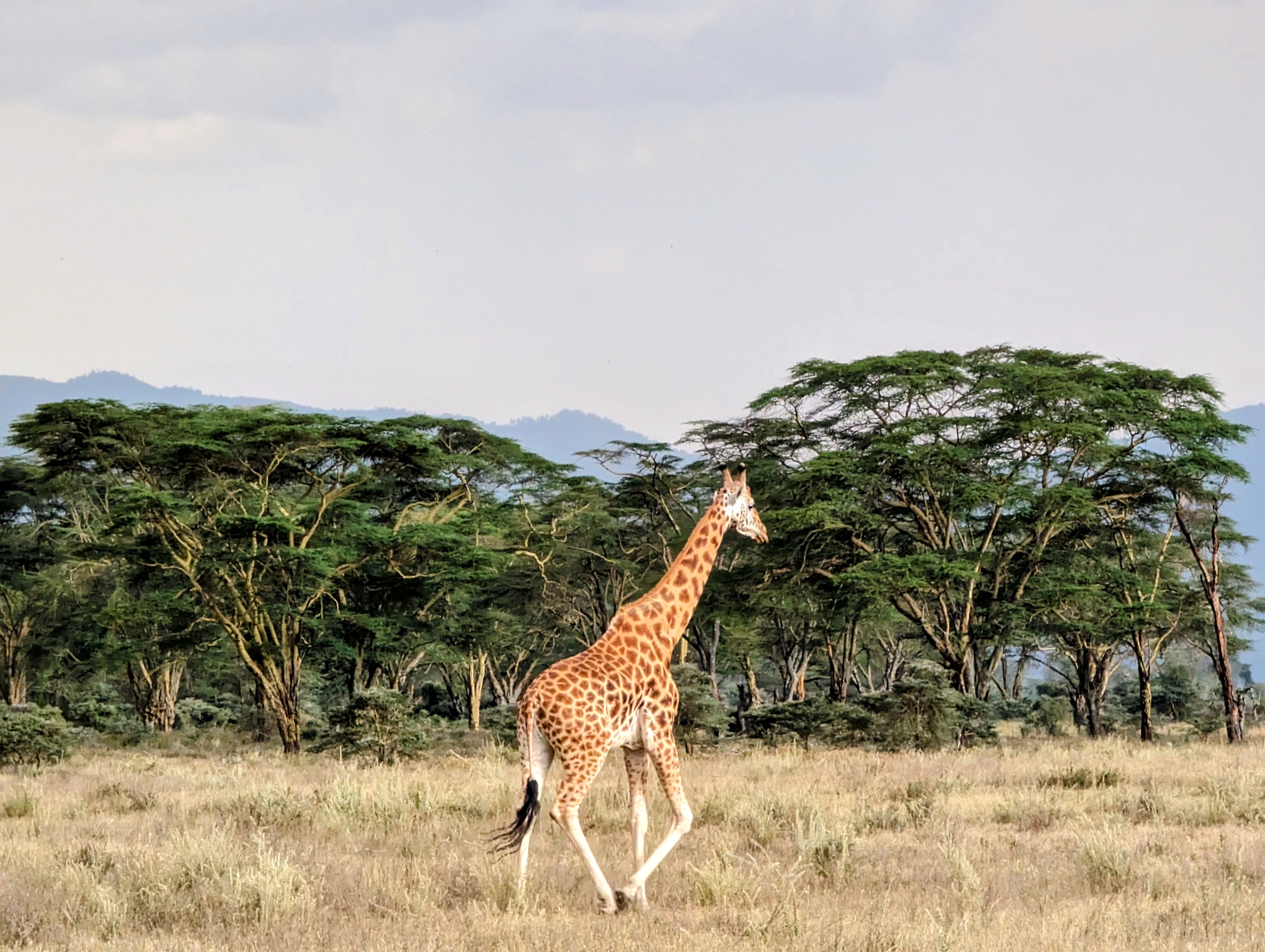
We took a boat out onto the lake with a local guide in the late afternoon. The hippos surface around the boat — vast, entirely unimpressed — and the sunset over the acacia-framed shoreline was one of those moments that you try to photograph and then eventually put the camera away for. The Crescent Island Game Sanctuary, a private island in the lake, allows walking among giraffe, zebra, and impala without a vehicle — the only place in the Mara ecosystem where this is possible. Walking at the same level as a giraffe, close enough to hear it moving through the grass, is a completely different experience to watching from a jeep.
Lake Nakuru — Flamingos & Rhinos
Lake Nakuru, a few hours north of Naivasha, is an alkaline lake in Lake Nakuru National Park. For years it was famous for hosting over a million flamingos — the shallows running pink to the horizon. Water levels have changed the numbers in recent years, but the lake still holds extraordinary concentrations of both lesser and greater flamingos, and the sight of thousands of them feeding in a single stretch of water remains unlike anything else.
The park is also one of Kenya's most important rhino sanctuaries — it holds both black and white rhino populations, and the conservation effort here is serious and visible. We found black rhino on our evening game drive: a mother and calf moving through the acacia scrub in the late afternoon light, the calf close to the mother in the way young animals stay near safety. Black rhino are critically endangered — roughly 5,500 remain globally — and seeing them in genuinely protected habitat felt like something that mattered beyond the usual terms of wildlife tourism.
The Rift Valley escarpment views from above the lake are the final thing to see before the drive back to Nairobi. From the ridge, the lake stretches out below — pink at the edges, blue in the centre, the valley walls on either side dropping in geological layers of brown and red and grey. It's a fittingly large-scale close to a trip that had been about scale all along.
The Thing About Africa
People tell you the safari changes you, and you file that away as the kind of thing people say about transformative experiences. Then you're sitting in a jeep at dawn watching a river crossing and understanding — really understanding — what it means to be in a world that was here for millions of years before you arrived and will be here long after. That feeling stays. It's worth going back for, which is the best thing that can be said about anywhere.