Taiwan had been on the list for a while. We'd talked about it for years — the night markets, the mountain railways, the paddy fields of the east coast — and when December opened up, we booked it properly. Ten days, a loose route from north to south, and a deliberate plan to go slower than we usually do. We're glad we made the time.
Taiwan is one of those places that doesn't announce itself loudly. It doesn't have the iconic skyline of Tokyo or the ancient grandeur of Kyoto. What it has instead is something harder to describe — a combination of warmth, creativity, natural beauty, and food that quietly adds up to one of the most rewarding travel experiences in Asia.
In This Post
Taipei — The City That Works
We landed at Taoyuan in the afternoon and took the metro straight into the city. The first thing you notice about Taipei is how functional everything is. The trains run on time, the signs are in English, the 7-Elevens are everywhere (and genuinely useful — you can pay bills, print boarding passes, buy SIM cards), and the whole city feels designed for humans rather than cars.
The neighbourhood around Da'an and Rongjin is where you want to spend your first afternoon. It's residential, leafy, and full of small cafés tucked between apartment blocks. We found Summer Savage Café by accident — one of those places with perfect coffee and better-than-average interior design — and spent longer there than planned, which is usually a sign that a city has you.
Yongkang Street is the food street that every post about Taipei mentions, and for good reason. It's not overly touristy, the food is exceptional, and the bubble tea here is legitimately great rather than a tourist experience. We had dinner standing up from a stall and it was one of the best meals of the trip.
The Da'an neighbourhood in Taipei — café culture, leafy streets, and some of the best casual food in the city.
In December, Taipei has CHRISTMASLAND — an enormous light festival centred on the New Taipei City Government complex that transforms the whole Xinyi district. It's genuinely spectacular in a way that doesn't feel corporate or forced. Taipei 101 lit up against the night sky behind it only made it better.
"Taiwan doesn't try to be impressive. It just is, quietly and consistently, in ways that take a few days to fully appreciate."
Taichung & The Mountains
The HSR from Taipei to Taichung takes exactly one hour and costs very little. Taichung is Taiwan's third city and its most liveable one — smaller than Taipei, easier to walk, with a creative energy that shows up in its cafés, art spaces, and street food culture.
Miyahara is the strangest and most wonderful place. It used to be an ophthalmology clinic. Now it's an ice cream parlour and chocolate shop housed in a beautifully restored brick building, with shelves of antique-looking tins and packaging that make it feel like stepping into a Wes Anderson film. The ice cream is very good. The experience is better.
From Taichung we made the move most tourists don't: we took the train to Chiayi and then Bus 7322 up into the Alishan mountain range to a tiny village called Shizhuo, at 1,100 metres elevation, surrounded by tea terraces draped in mist. We stayed at Drizzle Tea House. There were almost no other tourists. The trail through the tea gardens in the afternoon mist, with silence on all sides, is the kind of thing you remember years later.
The mist trail through Shizhuo's tea terraces at 1,100m. Most tourists go directly to Alishan — we stayed a night here and it was completely different.
The next morning we caught the bus up to Alishan itself for sunrise. The famous image — a sea of clouds below the peaks, turning orange and then gold as the sun climbs — is not exaggerated. We were not alone for it (a crowd had gathered), but it was one of those moments where the spectacle is big enough that other people don't diminish it. The Alishan Forest Railway through ancient cypress groves runs slowly and beautifully. The ancient trees — Sisters Pond, the Sacred Tree, the Three-Generations Tree — are extraordinary in a quiet way that photographs don't quite capture.
Practical Note
Book the Alishan Forest Railway in advance online — it sells out. Take the earliest bus up from Shizhuo for sunrise, around 4:30–5am. The light show is brief and worth the early wake.
The East Coast — Taitung & Chishang
The Puyuma Express cuts across the island from Chiayi to Taitung in about two and a half hours, and the journey itself is worth something — watching the terrain change from western plains to the Central Mountain Range and then down to the Pacific coast. Taitung is a different Taiwan entirely. Indigenous Paiwan and Amis cultures are present and visible here in ways that the west coast cities aren't. The pace drops immediately.
Tiehua Music Village — an outdoor live music and artisan market in former military warehouses — was where we spent our first evening. Local musicians, handmade ceramics, and a very relaxed atmosphere. It didn't feel like a tourist attraction. It felt like a neighbourhood doing something it actually cared about.
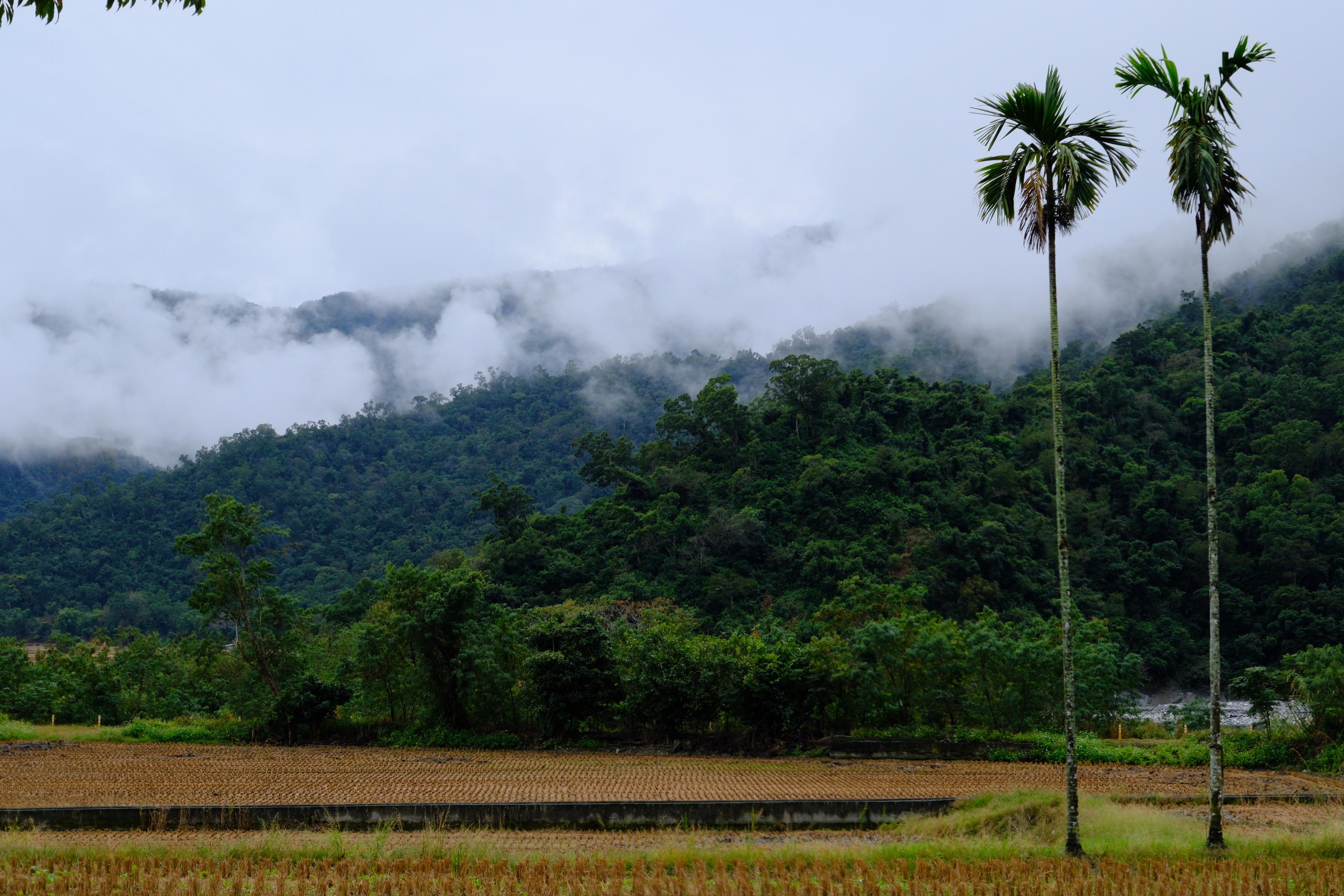
From Taitung we took the local train north to Chishang — a small farming town famous for its organic rice and for Brown Boulevard, a poplar-lined road cutting through paddy fields with the Central Mountains on one side and the East Rift Valley hills on the other. The light in the late afternoon makes the fields glow in a way that doesn't feel real. We walked it slowly, in both directions. There were almost no tourists. A few cyclists. Some farmers. The mountains went purple as the sun dropped.
Brown Boulevard in Chishang — poplar trees, golden paddy fields, and the Central Mountain Range. One of the most unexpectedly beautiful places in Taiwan.
The Chishang Barn Art Gallery is worth a visit too — a converted rice warehouse with contemporary art exhibitions that feel genuinely considered rather than tourism-adjacent. The bento boxes here are apparently famous across Taiwan (the railway bento is a whole thing), and we had one on the platform while waiting for the train, which is very much the correct way to eat them.
The next day: the Yufu Bikeway, a flat 10km cycling path through rice fields near Yuli, with unobstructed mountain panoramas on both sides. Rent a bike at Yuli station, leave luggage in a locker, cycle out and back at your own pace. It was two hours of the kind of uncomplicated happiness that travel occasionally delivers.
Tainan & Kaohsiung
Tainan is Taiwan's oldest city and its food capital, and both facts are taken very seriously by the people who live there. The Anping Tree House — a 19th-century warehouse that was abandoned and subsequently swallowed by banyan trees over several decades — is one of the genuinely strange and beautiful things we've seen anywhere. The roots now form the walls. The trees have become the building. It should feel like a tourist trap. It doesn't.
Shennong Street is the most atmospheric lane in Tainan — narrow, lined with old wooden apothecaries converted into indie cafés and design shops, with the sound of cooking coming from windows above. We spent an afternoon wandering it slowly and eating our way through. The milkfish congee and danzai noodles are both essential.
Anping Tree House — a 19th-century warehouse now entirely colonised by banyan roots. One of those places that photographs poorly and is extraordinary in person.
Kaohsiung is Taiwan's second city and operates at a different speed to Taipei — more port city than capital, more relaxed, with a harbour area (Pier-2 Art Centre) that reminds us slightly of repurposed industrial spaces in European cities. The Lotus Pond dragon and tiger pagodas, which you enter through the dragon's mouth and exit through the tiger's mouth to receive good luck, are gloriously over-the-top and completely earnest about it. Cijin Island, reached by a short ferry, has good seafood and a lighthouse walk with views back over the city.
We ended our last evening in Taiwan at Liuhe Night Market — Kaohsiung's best street food strip. Grilled squid, seafood congee, papaya milk, and more skewers than we could count. It was the right way to finish: standing up, a little overwhelmed, with food in hand.
Would We Go Back?
Yes. Without hesitation. There's a whole north coast we didn't see, hot springs we skipped, and the Taroko Gorge that we've been told we'll regret missing. Taiwan earns a second trip in a way that very few places do.